ICARSIS

ICARSIS - The Global Coalition
Science of Indigeneity

The science of indigeneity is often called Indigenous science or Indigenous knowledge. This is an age-old holistic, place-based system of understanding the natural world through long-term relationships with the land. It contrasts with Western science by being deeply relational, spiritual, and communal rather than reductionist or lab-siloed. However, owing to the fast-growing "rocket-science" of the modern era, we had little time to look back on our traditional practices and indigenous culture, especially the scientific valour in it that sustained it across varied socio-economies and contrasting geo-ecologies, over time and space. In this climate milieu, it's high time we understand the significance of our enriched traditional knowledge, sustainable lifestyles, indigenous resilient practices, and wise use of nature. ICARSIS embeds all of these in a cocoon of scholastic and pragmatic paraphernalia. Here we explore what exists.

Core Characteristics of Indigenous Science

icon
Relational and Connected: Indigenous science views all parts of the environment, animals, and humans as interconnected rather than separate or mechanistic. It assumes the creation (evolution) as a continuum of manifestation of nature rather than siloed actions or serendipity.
icon
Place‑Based Learning: Traditional practices and indigenous knowledge is carried down through generations via mentors on the land and oral histories rather than formal classrooms. It is shared with the ethics of purity, transparency and equity.
icon
Dynamic and Evolving: Indigenous knowledge is an age‑old learning that is not stuck in the past; it updates through ongoing observation, trial, error, and adaptation. It is the most empirical and evidence‑based adaptive learning that has sustainability as its central tenet.

Indigenous Knowledge and Modern Science
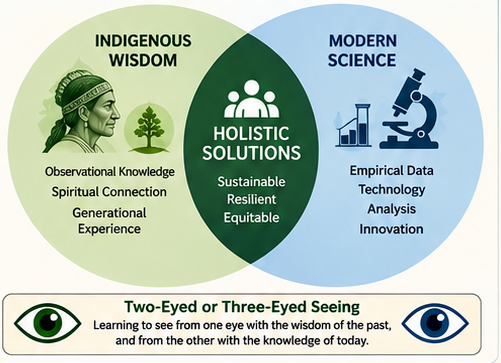
Indigenous science pairs with modern ecological management by combining long‑term local observations with empirical data, using frameworks like Two‑Eyed or Three‑Eyed Seeing to improve biodiversity, climate resilience, and sustainable resource use. This collaboration bridges traditional practices with Western scientific techniques for holistic environmental stewardship.
Venn diagram: Indigenous science and modern science

Key Integration Methods – some practical implications

icon
Controlled Burns: Indigenous fire management reduces severe wildfire risks by clearing fuel loads, adopted by modern forest agencies.
icon
Wildlife Co‑Management: Generational tracking of animal behaviours helps researchers adjust population surveys and quotas.
icon
Ecosystem Engineering: Restoring native migrations (e.g. buffalo) revives soil health and plant diversity.
icon
Agroforestry & Polyculture: Traditional intercropping and sacred groves protect soil nutrients and biodiversity.

Indigenous Science in Practice

icon
Controlled Burns: Indigenous fire management reduces severe wildfire risks by clearing fuel loads, a practice now adopted by modern forest agencies.
icon
Wildlife and Habitat Co‑Management: Long‑term generational tracking of animal behaviours helps modern researchers adjust population surveys and conservation quotas more accurately.
icon
Ecosystem Engineering: Restoring native species migrations—such as buffalo reintroductions—revives soil health and plant diversity better than standard industrial grazing.
icon
Agroforestry and Polyculture: Traditional intercropping and sacred grove preservation maintain soil nutrients and protect regional flora and fauna.
ICARSIS embeds traditional knowledge, sustainable lifestyles and resilient practices in a cocoon of scholastic and pragmatic paraphernalia.